
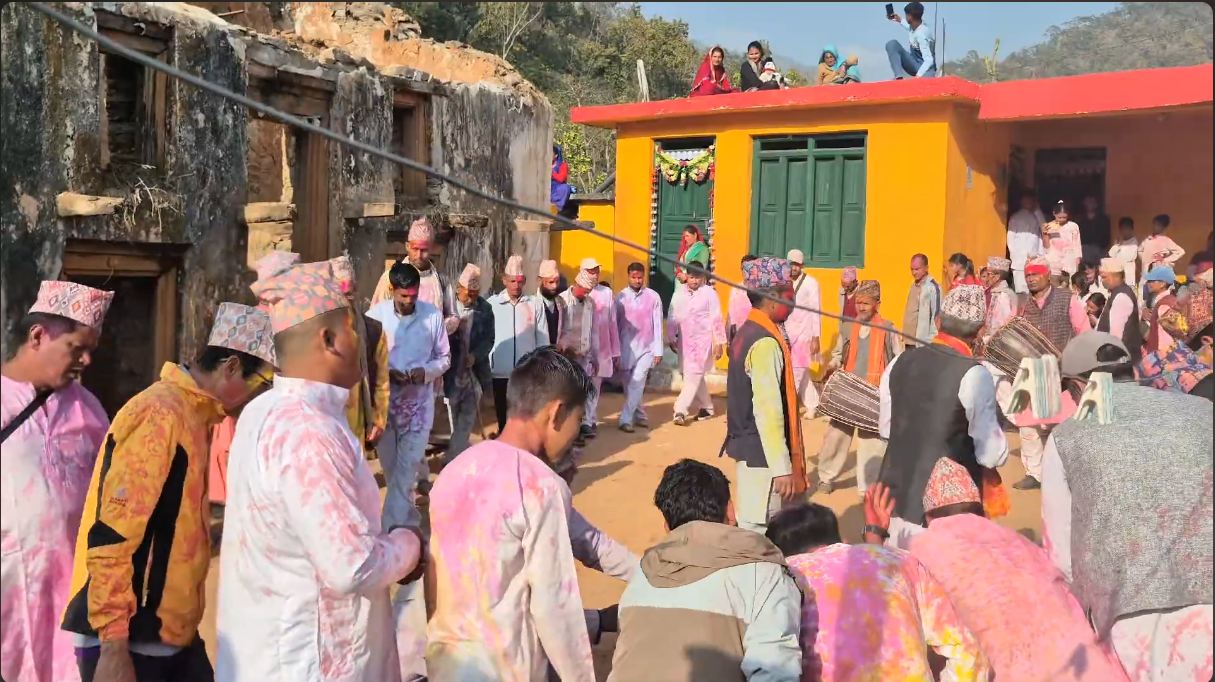
A Living Cultural Heritage from Thapala, Parshuram–3 , Dadeldhura
Dadeldhura, Sudurpashchim Province – Holi, widely known as the festival of colors, carries a distinct cultural and historical identity in Nepal’s far-western region. In the historic Doti Kingdom, the organized and traditional celebration of Holi is widely believed to have originated from Old Thapala of Rupal Garkha, currently located in Parshuram–3, Dadeldhura. Previously, the area was administratively recognized under the Sirsha Rural Development Area.
Unlike the one-day celebration observed in many parts of Nepal, Holi in the Doti region follows a structured and ritual-based tradition that begins on Falgun Shukla Ashtami and continues until Falgun Purnima (Full Moon). This eight-day period is locally known as Holastak, during which devotional singing, ritual performances, and community gatherings take place.
Historical Background: Beginning from Thapala
Local elders and cultural historians maintain that the formal and organized tradition of Holi within the Doti Kingdom began from Old Thapala of Rupal Garkha. From this cultural center, the tradition gradually spread to neighboring villages and across the wider Doti region.
Because of this historical belief, Thapala Holi is regarded not merely as a local celebration but as the foundational origin of Holi tradition in the former Doti state.
The Ritual of Chir Planting
The festival formally begins with the ritual known as Chir planting on Falgun Shukla Ashtami. During this ceremony, a branch of the Umro or Amla tree is decorated with colorful cloth pieces and ceremonially erected at a designated communal space.
The Chir symbolically represents Holika from Hindu mythology. On the night of Falgun Purnima, the Chir is burned in a ritual known as Holika Dahan, signifying the triumph of truth, devotion, and righteousness over evil.
Mythological Significance
The spiritual foundation of Holi is rooted in the legend of Prahlad and Holika. According to Hindu belief, Holika attempted to burn Prahlad, a devoted follower of Lord Vishnu, by sitting with him in a fire while wearing a divine protective cloth. Through divine grace, Prahlad survived, and Holika was reduced to ashes.
This event symbolizes the victory of unwavering faith and truth over arrogance and evil. The burning of the Chir during Thapala Holi represents this timeless moral message.
Unique Forms of Holi Singing
Thapala Holi is distinguished by its organized musical and devotional performances. The celebration includes three primary forms of Holi singing:
Uthi Holi – Sung while standing
Baithi Holi – Sung while seated
Bata Hori – Sung while moving from house to house
Participants perform in circular formations, synchronizing rhythmic foot movements with the beats of the dholak drum. The songs narrate stories from the lives of Lord Krishna, Lord Rama, Prahlad, and other mythological themes. Although influenced by the Braj Holi tradition, the performance style strongly reflects the Doteli language and local cultural expression.
Seasonal and Agricultural Importance
Holi in Doti coincides with the arrival of spring, a season marked by blossoming flowers and new vegetation. Traditionally, newly harvested grains such as wheat, barley, and gram are roasted and shared among community members during the festival.
The Sanskrit term “Hola,” meaning roasted grain, is believed by many scholars to be linguistically connected to the word “Holi.” This highlights the festival’s agricultural roots alongside its religious and cultural dimensions.
Ash Ritual and Symbolism of Colors
After Holika Dahan, ashes from the burned Chir are applied to the forehead as a sacred mark. In the Doteli language, ash is referred to as “Char,” and the practice of playing Holi with ash is locally known as Charedi.
The use of colors during the celebration carries symbolic meanings:
Red represents strength and prosperity
Yellow symbolizes divinity and spiritual energy
Green signifies growth and harmony
Blue reflects protection and righteousness
Traditionally, natural colors were used, which were believed to offer seasonal health benefits.
Cultural Identity and Community Unity
One of the most remarkable aspects of Thapala Holi is its role in preserving cultural continuity. Elders pass down songs, rhythms, and rituals to younger generations, ensuring the survival of oral traditions.
The celebration strengthens social harmony, promotes unity, and reinforces the cultural identity of the Doteli people. As modernization continues to influence rural communities, Thapala Holi remains a powerful symbol of heritage and regional pride in Sudurpashchim Province.
Conclusion
Thapala Holi of Rupal Garkha, Parshuram–3, Dadeldhura stands as a historically significant and culturally rich tradition believed to mark the origin of Holi in the Doti Kingdom. More than a festival of colors, it represents devotion, seasonal renewal, agricultural gratitude, and communal solidarity.
Preserving this living heritage is essential for safeguarding the historical and cultural identity of the Doti region for future generations.


Very nice
Sushma Swaraj
March 15, 2026 am31 5:55 AM